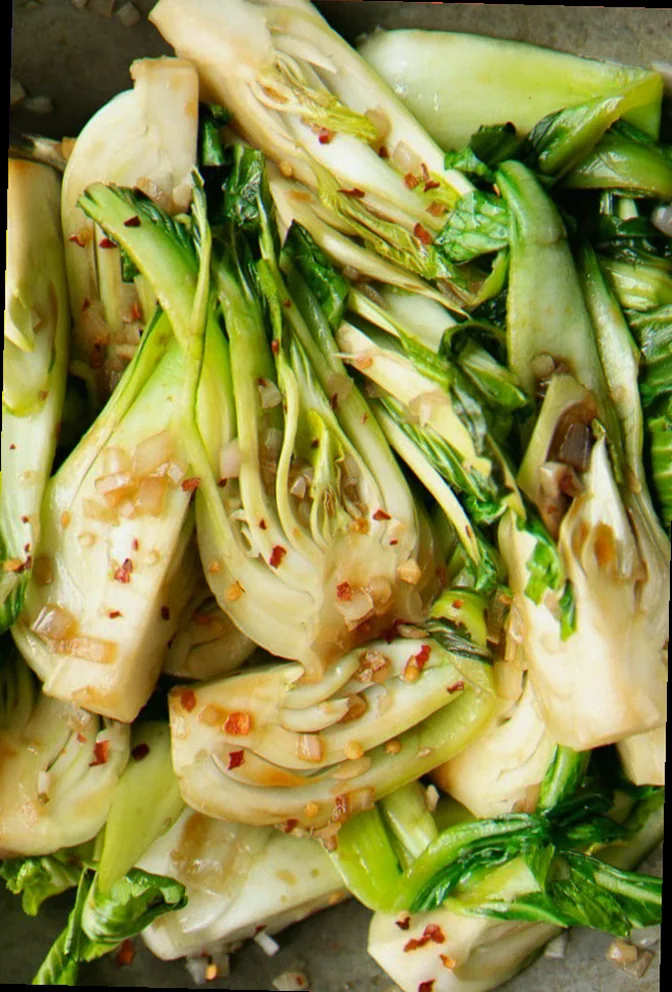
I spent three years getting vegan baby bok choy recipes wrong before I understood that this vegetable is not a cabbage to be boiled, but a steak to be seared. The first time I tried making it, I ended up with a pile of grey, translucent sludge that tasted like a wet basement. I followed a generic recipe that told me to “steam until tender,” which is essentially code for “rob the vegetable of its soul.” It wasn’t until I stumbled upon the Lengthwise Steam-Sear that everything changed. This single revelation transformed my kitchen from a place of soggy greens to a sanctuary of crisp-tender, umami-rich perfection. Once you realize that the white bulb needs heat and the green leaf needs a light touch, you stop cooking bok choy and start engineering it.
Why Most Versions of the “Sautéed Green” Fail
The biggest mistake people make—the one I call the “Boiled-then-Sautéed Disaster”—is treating bok choy as a homogenous mass. Most home cooks chop the leaves off, throw everything into a pan with some oil, and hope for the best. What they get is a textural nightmare: the leaves turn into a slimy, overcooked film while the thick, fibrous stems remain raw and crunchy in the middle. It’s a dish of extremes that satisfies no one. If you aren’t creating a high-contrast environment where the stems are caramelized and the leaves are merely wilted, you aren’t making a recipe; you’re making a mistake. You want a deep, mahogany char on the flat face of the stalk, contrasting with a vibrant, emerald green leaf that still has its structural integrity.
The Ingredients That Actually Matter
I don’t just “use” ingredients; I’ve vetted them through a dozen failed dinners. It starts with 500g of baby bok choy—and I mean “baby.” If the heads are longer than your hand, they are too old, too fibrous, and too bitter. I look for tightly packed bulbs that feel heavy for their size. To season them, I’ve moved away from standard soy sauce. I use 45ml of Tamari instead; its fermented depth is far superior for vegan dishes where you’re lacking animal fats.
Then there’s the sweetness. I used to use brown sugar, but it never dissolved right. Now, I use exactly 15ml of Grade A maple syrup. It provides a floral note that bridges the gap between the bitter greens and the salty Tamari. For the aromatics, I’ve learned to be aggressive. I use 20g of fresh ginger, grated into a paste so it coats every crevice, and 15g of garlic—about four large cloves—smashed and minced. The fat is non-negotiable: 15ml of toasted sesame oil for the finish, but I start the sear with 20ml of a neutral, high-smoke-point oil like grapeseed. If you try to sear in sesame oil from the start, it will burn and turn acrid before the bok choy even gets warm. Finally, a sprinkle of 2g of red pepper flakes provides the back-of-the-throat heat that cuts through the richness of the glaze.
The Moment Everything Changes: The Lengthwise Steam-Sear
The single technique that saved my kitchen was learning to slice the bok choy in half lengthwise, right through the root, and using the Lengthwise Steam-Sear. By keeping the root intact, you hold the leaves together, but by exposing the flat interior of the bulb, you create a massive surface area for caramelization. The “Steam-Sear” is the magic trick: you place the vegetable cut-side down in a ripping hot pan to develop a crust, then add a tiny splash of liquid and cover it for exactly sixty seconds. This flash-steams the dense stems using the vegetable’s own moisture, ensuring the center is tender without the leaves turning to mush. Before I learned this, I was always chasing my tail—either the stems were rocks or the leaves were slime. Now, they finish at the exact same millisecond.
How I Actually Make It Now — Step by Step
I don’t follow a clock; I follow my senses. Here is how I orchestrate the perfect plate.
The Prep and Dry: I take my 500g of bok choy and slice each head in half lengthwise. I wash them in cold water, but here is the critical part: I dry them like my life depends on it. If they are wet when they hit the pan, they will steam immediately and you will never get a sear. I use a clean kitchen towel to pat every single crevice.
The Cold-Start Aromatics: In a small bowl, I whisk together the 45ml of Tamari, 15ml of maple syrup, and the 20g of grated ginger. I keep the garlic separate because it’s a diva and will burn if I look at it wrong.
The High-Heat Sear: I get my heavy stainless steel or cast iron pan over medium-high heat until the 20ml of grapeseed oil is shimmering and just starting to wisps of smoke. I place the bok choy halves cut-side down. I don’t move them. I want to hear a violent sizzle. I press down on them with a spatula for about 2 minutes until the bottoms are a deep, golden brown.
The Flash-Steam: I toss in the 15g of minced garlic and the 2g of red pepper flakes, letting them hit the oil in the gaps between the vegetables. After about 30 seconds, when the garlic smells like heaven, I pour in the Tamari-maple-ginger mixture. It will bubble violently. I immediately slap a lid on the pan and count to sixty. This traps the steam and softens the hearts.
The Glaze Reduction: I pull the lid off. The liquid will still be thin. I turn the heat to high and move the bok choy around, coating them as the sauce reduces into a sticky, glossy glaze that clings to the leaves. This takes maybe 45 seconds.
The Finish: I pull the pan off the heat and drizzle the 15ml of toasted sesame oil over the top. The residual heat is enough to wake up the aroma of the sesame without scorching it. I serve it immediately while the stems are still snapping.
The Failures I Still See — and How to Fix Them
- The Sallow Swimmers: If your bok choy is sitting in a pool of grey liquid, you didn’t dry the vegetable enough or your pan wasn’t hot enough. Fix: Next time, use a larger pan (or cook in two batches) and ensure the oil is shimmering before the veg hits the metal.
- The Bitter Burn: If the garlic tastes like charcoal, you put it in too early. Fix: Always add the garlic right before the liquid. The moisture from the sauce drops the pan temperature and prevents the garlic from carbonizing.
- The Woody Core: If the leaves are perfect but the base is like chewing on a pencil, you skipped the lid. Fix: That 60-second covered steam is mandatory. It’s the only way to cook the dense core without ruining the delicate tops.
When I Make This and What I Serve It With
This is my “reset” meal. I make this on Tuesday nights when I’ve had too much takeout and need to feel like a functioning human again. It earns its place on the table because it’s fast—start to finish in ten minutes—but feels like a luxury.
I almost always serve this alongside a block of 400g extra-firm tofu that I’ve pressed and pan-fried until crispy. The crunch of the tofu is the perfect foil for the tender-crisp bok choy. I also serve it with a bowl of short-grain brown rice to soak up every last drop of that ginger-tamari glaze. For a drink, I find a cold glass of dry Riesling works wonders; the acidity and slight petroleum notes of the wine play beautifully with the earthy, toasted sesame oil.
Substitutions I’ve Tested Honestly
- Tamari → Coconut Aminos: I tried this for my soy-free friends. It’s significantly sweeter and lacks the salt punch. If you do this, skip the maple syrup entirely and add a pinch of sea salt, or the dish will taste like dessert.
- Maple Syrup → Agave: This works perfectly fine. The flavor profile is more neutral, but the caramelization properties are identical.
- Baby Bok Choy → Full-Sized Bok Choy: I don’t recommend it. I’ve tried chopping the big ones into 5cm chunks, but the texture is never as refined. The stalks are too stringy. If you must use the big ones, peel the outer layers off and only use the tender inner heart.
Questions I Get Asked About This Dish
Do I really need to cut them in half?
Yes. If you leave them whole, the inner layers will be raw while the outer layers turn to mush. Cutting them in half is the only way to season the center of the vegetable.
Related topics: Vegan baby food recipe book · Vegan mashed sweet potato recipes · Peta vegan recipes christmas
Can I make this ahead of time for meal prep?
Absolutely not. Bok choy is a “moment-of” vegetable. If it sits in a Tupperware container for four hours, it will continue to cook in its own residual heat and turn into the very sludge we are trying to avoid. Eat it fresh or don’t eat it at all.
Why is my sauce not thickening?
You probably didn’t let the liquid reduce enough after taking the lid off. Turn that heat up! You want the sugars in the maple syrup and Tamari to concentrate until they form a syrup that coats the back of a spoon. If it’s watery, keep boiling.